
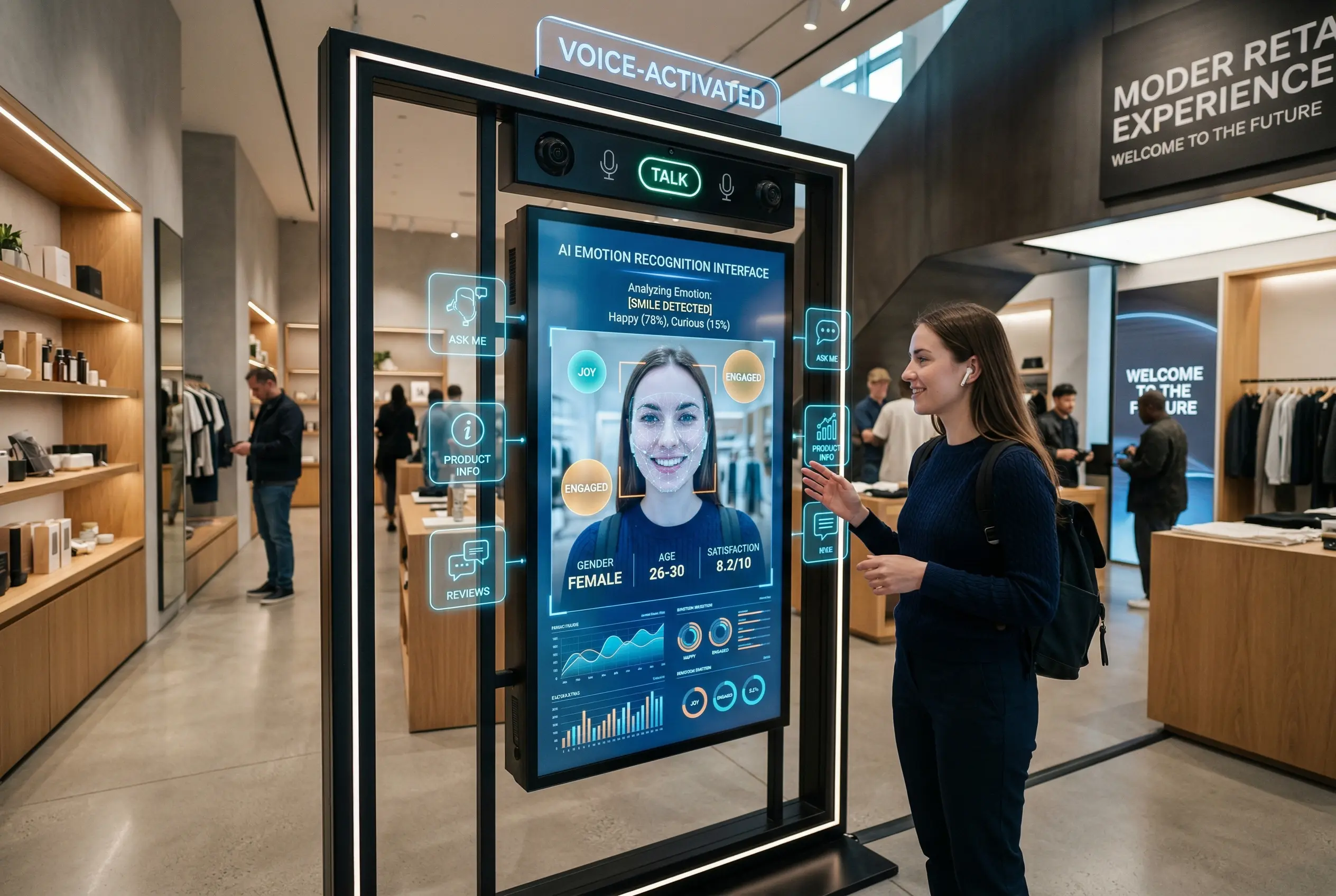
The digital signage landscape has reached an inflection point. In 2026, screens are no longer passive recipients of content—they are intelligent listeners that respond, adapt, and engage based on how customers interact with them. Two breakthrough technologies are leading this transformation: voice activation and emotion recognition AI. For businesses in Dubai and across the GCC, this shift represents a massive opportunity to move beyond traditional displays into next-generation customer experiences.
From Touch to Voice: The Hygiene & Accessibility Revolution
Touchscreens have been the standard for interactive displays for nearly two decades. But as hygiene consciousness rises and accessibility demands increase, the industry is pivoting toward touchless interfaces. Voice activation sits at the forefront of this shift.
Imagine a customer walking into a retail store and simply saying, "Show me winter jackets" to a digital display. Within seconds, inventory appears on the screen—filtered by size, price, color, and availability. No touching. No navigating menus. No frustration. This is voice-activated signage in 2026.
The business case is compelling:
- Hygiene improvements: Reduces pathogen spread in shared touchpoints, especially critical in hospitality and healthcare.
- Accessibility: Enables visually impaired and mobility-limited customers to interact with signage independently.
- Speed: Voice commands are faster than navigating multi-level menus, reducing customer friction.
- Natural interaction: Customers don't need to learn a system—they speak as they would to a person.
Technologies like Amazon Alexa, Google Assistant, and custom voice AI models are being embedded into digital signage platforms. Advanced NLP (natural language processing) understands regional accents, Arabic dialects, and multi-language queries—critical for Dubai's diverse population.
Emotion Recognition: Reading the Unspoken Customer
Voice activation gets customers started, but emotion recognition AI takes personalization to a deeper level. Using facial emotion detection, displays can now understand how customers feel in real-time and adapt content accordingly.
Here's how it works: A camera integrated into the digital signage captures the viewer's facial expressions using advanced AI models trained on micro and macro facial cues. The system identifies seven core emotions: joy, sadness, anger, surprise, fear, disgust, and neutral. In milliseconds, it combines these signals to determine whether a customer is engaged, confused, interested, or disengaged.
Real-world applications in retail:
- Dynamic content switching: If a customer looks confused, the display automatically simplifies the message or offers a guided tour via voice.
- Product recommendations: When emotion recognition detects interest (elevated engagement signals), the display highlights complementary products with personalized CTAs.
- Sales lift: Studies show emotion-responsive signage increases in-store sales by up to 29.5%.
- Offline feedback loop: All analysis happens locally on-device—no faces are sent to the cloud, ensuring GDPR compliance and customer privacy.
This technology is particularly powerful in hospitality, luxury retail, and airports—environments where customer mood directly impacts purchasing behavior and satisfaction.
The Tech Stack: BrightSign + AI = Smart Displays
At DigiComm, we integrate emotion recognition and voice-activation capabilities with BrightSign media players—the gold standard for reliable, enterprise-grade digital signage. Here's why this combination works:
- BrightSign's robustness: 99.99% uptime, native HTML5 support, and cloud management mean displays run flawlessly 24/7.
- AI integration: BrightSign's Edge AI capabilities allow emotion detection and voice recognition to run directly on the player, eliminating latency and external API dependencies.
- Real-time content adaptation: Using APIs and webhooks, the system instantly adjusts messaging based on emotional state or voice input.
- Analytics at scale: DigiComm's studio team combines engagement metrics with demographic insights to optimize content performance across your network.
Why This Matters for Dubai in 2026
Dubai's retail and hospitality sectors are hyper-competitive. Customers expect personalization, efficiency, and innovation. Voice-activated and emotion-responsive signage deliver all three:
- For retail: Reduce dwell time, increase conversion rates, and gather behavioral intelligence for inventory optimization.
- For airports & hotels: Enhance wayfinding, personalize offers based on traveler mood, and reduce staff burden.
- For healthcare: Provide accessible, hygienic patient information systems that respond to patient needs in real-time.
- For events: Create immersive activations where displays respond to attendee emotions and voice commands, turning passive viewing into active engagement.
Privacy & Ethics: The Responsible AI Approach
With great power comes great responsibility. Emotion recognition and voice capture raise legitimate privacy concerns. The key is edge-based processing—analysis happens locally on the display, not in the cloud.
Unlike centralized systems that store face images for re-identification, responsible emotion AI systems (like MoodMe) process video frames in real-time and discard them immediately. Only aggregated emotion metrics leave the device. This approach is:
- GDPR-compliant: No personal biometric data is stored or transmitted.
- Transparent: Customers can be informed via signage that emotion detection is in use, giving them agency.
- Secure: No risk of data breaches involving sensitive facial information.
Getting Started: Your Voice & Emotion Signage Strategy
Implementing voice-activated and emotion-responsive signage isn't just about installing new hardware. It requires a strategic approach:
- 1. Audit your current displays: Which locations would benefit most from voice and emotion capabilities?
- 2. Integrate with your data: Connect signage to your POS, inventory, CRM, and customer database for full personalization.
- 3. Create dynamic content: Work with DigiComm's studio team to develop adaptive content that changes based on emotion and voice input.
- 4. Optimize continuously: Monitor engagement metrics, refine emotion thresholds, and test new voice commands.
At DigiComm, we've already deployed voice and emotion-responsive signage for retail clients across the UAE. The results speak for themselves: higher engagement, faster customer journeys, and deeper behavioral insights.
The Future Is Conversational
By 2026, the interaction model between customers and retailers is fundamentally changing. Instead of passive observation or forced menu navigation, customers simply speak their needs and see displays that understand their emotional state.
This convergence of voice AI, emotion recognition, and reliable hardware like BrightSign positions Dubai's businesses at the forefront of global retail innovation. The question is no longer whether to adopt these technologies—it's how quickly you can implement them to stay competitive.
Ready to transform your customer experience with voice and emotion-powered signage? Explore DigiComm's Solutions for BrightSign deployments, or connect with our Studio team to design custom AI-driven content strategies tailored to your brand.