
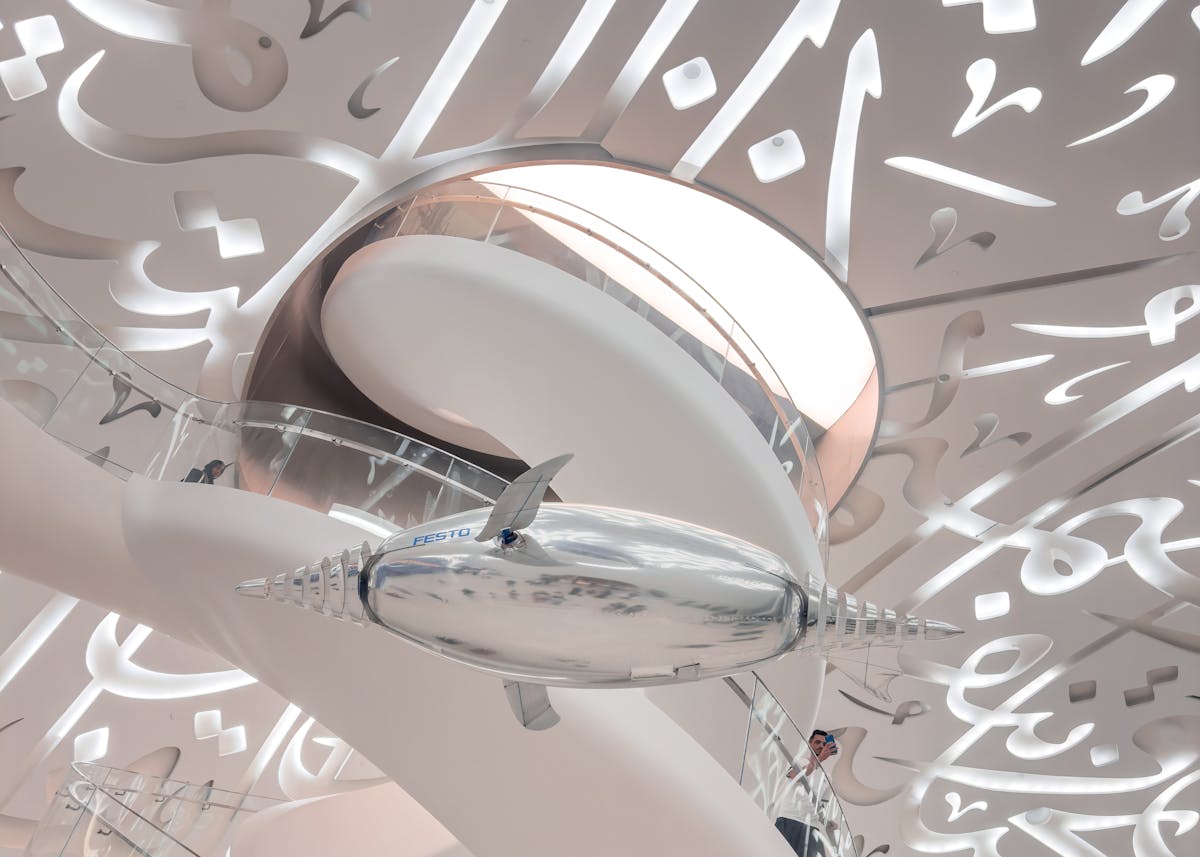
In May 2026, Dubai did something no city in the Middle East had ever attempted. Her Highness Sheikha Latifa bint Mohammed bin Rashid Al Maktoum officially launched the Museum of Digital Art — MODA — within the DIFC Zabeel District, a five-floor institution purpose-built for digital art, immersive installations, and AI-driven artistic experiences. It is the region's first permanent museum dedicated exclusively to new media and technology-driven art.
For the AV and events industry, this is more than a cultural milestone. MODA is a proof of concept — a live demonstration of what happens when world-class audiovisual technology, curated digital content, and architectural ambition come together at scale. And for anyone building experiences in Dubai, the implications are significant.
What MODA Tells Us About Dubai's Direction
MODA is not being built in isolation. It sits at the centre of a broader transformation of the DIFC Zabeel District — a $27 billion redevelopment project turning one of Dubai's most prestigious financial zones into a tech and creative hub. The museum's architecture, designed by Adrian Smith + Gordon Gill Architecture, reflects the ambition: a structure that functions as both building and canvas, designed to accommodate the kind of large-format, immersive AV installations that traditional museums simply cannot support.
What this signals for the market is clear. Dubai is no longer content to host world-class exhibitions temporarily. It is building permanent infrastructure for digital and immersive experiences — and that infrastructure requires advanced AV systems at every level.
The AV Technology Powering Modern Digital Art Museums
MODA's launch offers a useful lens through which to understand the technology stack behind the world's most compelling immersive museums. While the specifics of MODA's installations are still being revealed, the global playbook for institutions like this is well-established, and the components are increasingly accessible to commercial clients.
Large-format LED video walls have become the default backdrop for immersive digital art exhibitions. Where projection mapping was once the dominant tool, LED's superior brightness, colour accuracy, and seamless scalability — especially at fine pixel pitches — have made it the preferred medium for permanent installations. For museums where ambient light cannot be fully controlled, LED delivers consistent visual impact that projection cannot match.
Projection mapping and volumetric displays remain critical for three-dimensional and architectural installations. The technology allows art to break free of flat surfaces — mapping onto irregular shapes, walls, ceilings, and even visitors themselves. The Museum of the Future, which continues to set the benchmark for immersive AV in Dubai, uses projection mapping extensively across its multi-sensory exhibitions.
Interactive sensor networks — including motion detectors, pressure mats, and proximity sensors — transform passive viewing into active participation. Visitors do not simply observe digital art; they influence it. This is where technology like Nexmosphere's sensor ecosystem becomes relevant: enabling real-time, data-driven interactions that make each visit unique.
Spatial audio systems complete the experience. Immersive sound design — using directional speakers, ambient soundscapes, and object-based audio — ensures that what visitors hear matches what they see, creating environments that feel genuinely multi-sensory rather than visually dominant.
Why This Matters for Venues and Event Organisers
The museum model is increasingly being borrowed by commercial venues. The same technology stack that powers MODA — LED walls, projection mapping, interactive sensors, spatial audio — is now standard at high-end corporate events, brand activations, luxury retail environments, and gala dinners in Dubai.
The reason is simple: attention. In a city where every brand is competing for the same audience, an immersive AV experience creates a memory. Static displays and conventional stage setups no longer differentiate events. Organisations that invest in the technology stack — and the content to run on it — are the ones that get remembered.
This is particularly relevant for the MICE (Meetings, Incentives, Conferences, and Exhibitions) sector in Dubai. The city hosted Integrate Middle East 2026 in late May at the Dubai World Trade Centre — a trade show specifically focused on Pro AV and systems integration, bringing together the manufacturers, integrators, and specifiers who build these experiences. The conversations happening at events like these are directly influencing what gets installed in venues across the city.
The Business Case for Immersive AV Investment
For decision-makers evaluating AV investment, the museum context provides useful reference points. Digital art institutions operate under unique constraints: they need to maintain visual impact across long hours of continuous operation, handle diverse content across rotating exhibitions, and deliver a consistent experience regardless of visitor volume. These are the same requirements that apply to retail environments, corporate lobbies, and event venues.
The hardware has also become more accessible. LED video walls with fine pixel pitches — once reserved for premium installations — have dropped significantly in cost since 2020. Cloud-based content management systems mean that content updates no longer require on-site technical staff. And AV-over-IP infrastructure, which distributes audio and video over standard network infrastructure, has dramatically reduced the complexity and cost of multi-screen installations.
The result is that immersive AV is no longer the exclusive domain of institutions with museum-sized budgets. The same technology decisions being made for venues across Dubai right now — the choice of LED versus projection, the decision to invest in interactive sensors, the adoption of cloud CMS platforms — are directly informed by the institutional standards being set by places like MODA.
How DigiComm Supports Immersive AV Projects
At DigiComm, we work with venues, event organisers, and brands across the UAE to specify, design, and deploy the AV systems that power immersive experiences. As master distributors for BrightSign media players, Nexmosphere interactive sensors, and SwedX display technologies across the MEA region, we provide the hardware foundation — but more importantly, we provide the integration expertise to ensure those components work together as a cohesive system.
Whether you are planning a permanent installation in a corporate lobby, a temporary activation for a product launch, or a full-scale immersive experience for several thousand guests, our team can walk you through the technology decisions that matter — from pixel pitch selection to content management architecture.
The opening of MODA is a reminder that Dubai's ambition in the experiential space is not slowing down. The question for businesses and venues is whether their AV infrastructure is keeping pace.