Hybrid work is no longer a trend—it's the new normal. But it's created a challenge that no email or Slack message can fully solve: how do you maintain a unified company culture when your teams are scattered across offices, remote spaces, and flexible work arrangements?
In 2026, digital signage has evolved from a lobby decoration into the backbone of internal communications infrastructure. For enterprises in Dubai and across the GCC, it's becoming the fastest, most visible way to connect boardroom strategy with daily employee execution.
The Problem With Traditional Internal Communications
Email broadcasts get lost. Intranet updates go unread. Virtual townhalls have poor attendance. And for employees moving between offices or hot-desking spaces, key information simply doesn't reach them reliably.
This gap costs organizations more than engagement—it costs alignment, compliance, and retention. When employees feel out of the loop, they disengage. When recognition happens behind closed doors, morale suffers. When emergencies hit, slow communication becomes a liability.
Digital signage solves this by placing real-time, visible information in the spaces where employees already are: lobbies, break rooms, corridors, meeting areas, and collaboration zones.
What Makes Digital Signage Different in 2026?
It's not just about displaying slideshows of company updates. Modern corporate digital signage integrates with your existing systems—Salesforce, Tableau, Google Workspace, HR tools, and compliance platforms—to become a living, data-driven communication channel.
Here are the top use cases driving adoption across enterprises:
1. Real-Time KPI Dashboards & Transparency
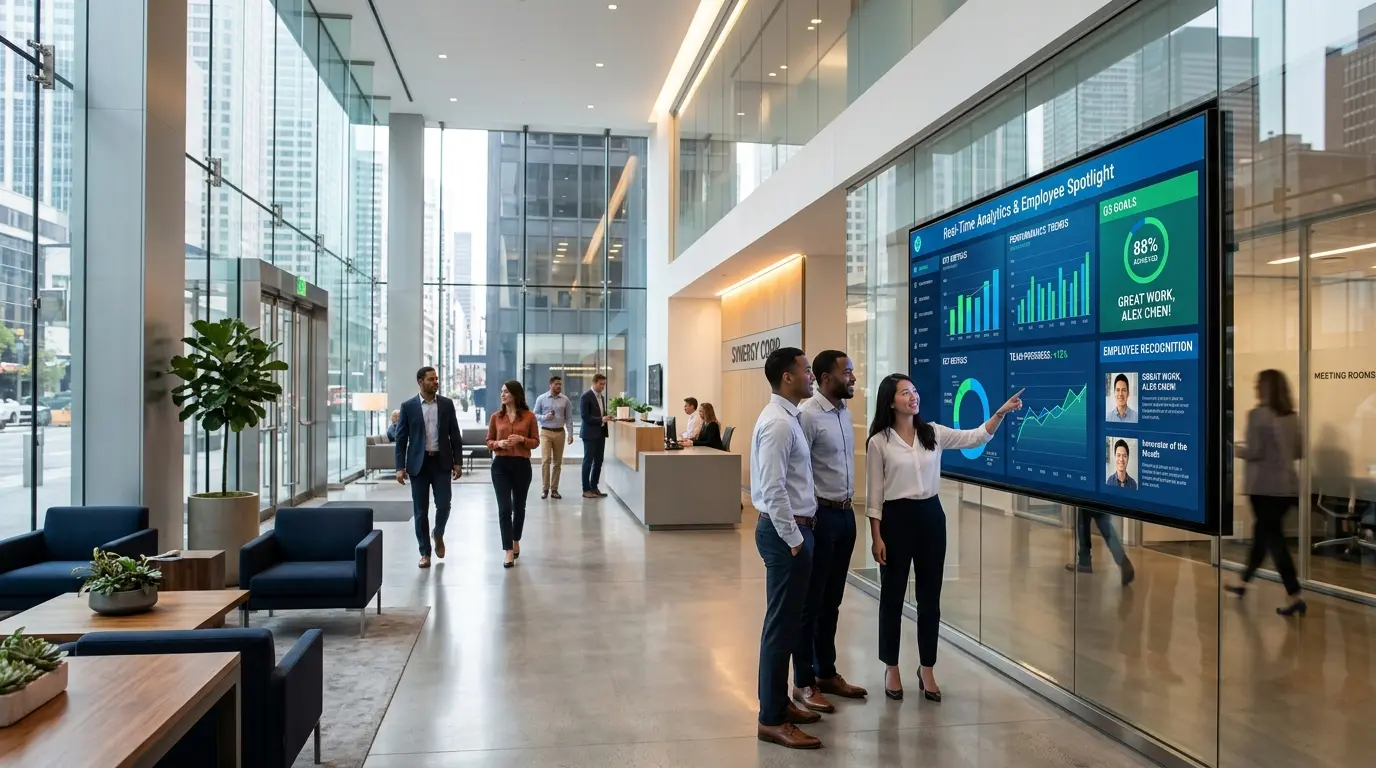
Static quarterly reports are dead. In 2026, high-performing teams use digital signage to display live KPI visualizations: sales targets vs. actuals, customer support metrics, production uptime, revenue pipelines, and team performance indicators.
This keeps everyone aligned on shared goals without waiting for all-hands meetings. Employees see progress in real time. Accountability becomes visible. And data-driven conversations happen naturally, right there on the screen.
For organizations operating across the UAE and GCC, this is especially powerful for coordinating teams across multiple locations and time zones.
2. The "Digital Watercooler": Social & Cultural Integration
Your team's achievements matter—but they only drive engagement if people see them. Digital signage can aggregate your company's LinkedIn mentions, Instagram posts, event hashtags, and internal wins into a "Digital Watercooler" effect that breaks down silos.
What happens? Remote employees see what HQ teams are achieving. Marketing sees what sales accomplished. The public sees what your brand stands for. Instant validation. Visible pride. Stronger culture.
3. Employee Recognition & Milestone Celebrations
Retention is driven by appreciation—but only when recognition is public, immediate, and celebrated. Quiet emails don't cut it.
Use digital signage to showcase:
- "Employee of the Month" features with personal stories
- Work anniversaries and tenure milestones
- Certification completions and skill achievements
- "Kudos" cards submitted by peers
- Team wins and project completions
When these moments are displayed across the entire company, remote and in-office employees feel equally celebrated. This directly improves retention and psychological safety.
4. Smart Wayfinding & Meeting Room Management
As offices downsize and hybrid work expands, spaces become more fluid. Meeting rooms change. Desk assignments shift. Employee confusion kills productivity.
Digital signage panels outside glass walls can show real-time room availability, upcoming bookings, occupancy status, and even desk availability. This eliminates the awkwardness of interrupting meetings and helps employees find focus space faster.
For organizations with multiple facilities across Dubai, Abu Dhabi, and other emirates, centralized smart navigation is a game-changer.
5. Emergency Alerts & Safety Protocols
Safety compliance isn't optional. In 2026, digital signage is your fastest emergency broadcast system. With a single click, override all content to display:
- Fire escape routes and assembly points
- Severe weather warnings and shelter information
- Health protocols and safety procedures
- Facility alerts (power outages, security events)
- Evacuation status and instructions
This is infrastructure you hope never to use—but it's essential for compliance and peace of mind, especially in the UAE where safety standards are strict.
How to Implement Corporate Digital Signage in 2026
Start With Strategy, Not Screens
The biggest mistake companies make is buying hardware first. Instead:
- Identify 1–2 high-impact communication journeys (e.g., daily operations, employee recognition, safety messaging, onboarding)
- Define outcomes and ownership (Marketing? HR? Facilities? Operations? IT?)
- Get stakeholders aligned on content governance before you deploy
- Pilot in one location with proper measurement
- Scale what works
Choose a Platform That Integrates
Standalone signage systems are dead ends. Your platform must:
- Connect to identity systems (SSO, role-based access)
- Integrate with workplace tools (room booking, shift schedules, employee directories)
- Pull live data from business systems (Salesforce, Tableau, Google Sheets)
- Support content governance (approvals, audit trails, compliance)
- Work offline if the network goes down
Design for Your Audience
Not all screens are the same. Consider:
- Lobby/main entrance: Brand presence, visitor welcome, key announcements
- Break rooms & common areas: Cultural content, recognition, social feeds
- Corridors & transitions: Wayfinding, safety, quick updates
- Meeting rooms: Room status, agenda info, emergency protocols
- Near workstations: Real-time KPIs, production metrics, team dashboards
Each placement should have a clear communication purpose.
Measure What Matters
Track:
- Engagement: dwell time, repeat visitors, content interaction
- Knowledge: employee comprehension of key messages (surveys)
- Behavior: adoption of announced processes or safety protocols
- Retention: correlation between recognition visibility and employee tenure
- Compliance: emergency notification delivery time
Why This Matters for Dubai & GCC Organizations
The UAE's rapid business growth creates unique challenges:
- Distributed teams: Regional offices across Dubai, Abu Dhabi, Doha, Riyadh
- Expat workforce: Multilingual communication needs (Arabic, English, more)
- Compliance pressure: Local labor laws, safety regulations, audit trails
- Fast growth: Companies scaling from 50 to 500+ employees fast
- Competitive talent market: Retention and culture matter more than ever
Digital signage addresses all of these at scale—instantly deployable, multi-language capable, compliance-audit-ready, and culture-building.
The Hardware: What You Actually Need
Overkill displays aren't necessary. For corporate internal communications, you typically need:
- 43–55" commercial LCD displays for lobbies and main areas (high brightness, continuous duty, good viewing angles)
- 32–43" displays for corridors, meeting rooms, break areas
- Interactive kiosks (21–32" touchscreen) for wayfinding, check-in, self-service
Pair these with:
- Media players (BrightSign is the industry standard for reliability and integration)
- Cloud management software (for remote scheduling, content approval, analytics)
- Sensors (occupancy, proximity) to enable context-aware messaging
- Backup connectivity (offline playback for when networks falter)
The total cost per location is usually lower than you'd expect—and the ROI comes fast through reduced miscommunication, faster compliance signoff, and improved employee retention.
Common Pitfalls to Avoid
Pitfall #1: "Set it and forget it" content. Static slideshows get ignored. Refresh content weekly. Link it to real business events, team milestones, and seasonal changes.
Pitfall #2: No governance. Without approvals and compliance workflows, signage becomes marketing chaos. Define who can publish what, how fast changes go live, and who audits for brand/compliance.
Pitfall #3: Ignoring privacy. If you're using sensors or cameras, privacy-by-design isn't optional. Clearly disclose what's being collected, who has access, and how long data is retained.
Pitfall #4: Underestimating implementation. Content strategy, stakeholder alignment, and training take time. Budget 2–3 months for a thoughtful pilot, not 2 weeks.
The Bottom Line
In 2026, corporate digital signage isn't a "nice to have." It's infrastructure.
Organizations that nail internal communications—keeping teams aligned, celebrating wins, responding to emergencies, and guiding people through spaces—outperform their peers on engagement, retention, and operational efficiency.
The technology is proven. The playbooks are clear. The question isn't whether to deploy digital signage for internal communications—it's how fast you can start.
If you're ready to modernize your corporate communications strategy, DigiComm's team can help you assess your needs, design a scalable platform, and execute a pilot that drives real results. We've built internal communications networks for enterprises across the UAE, from multi-location rollouts to specialized installations.
Let's talk about what your organization could achieve with the right signage infrastructure in place.