
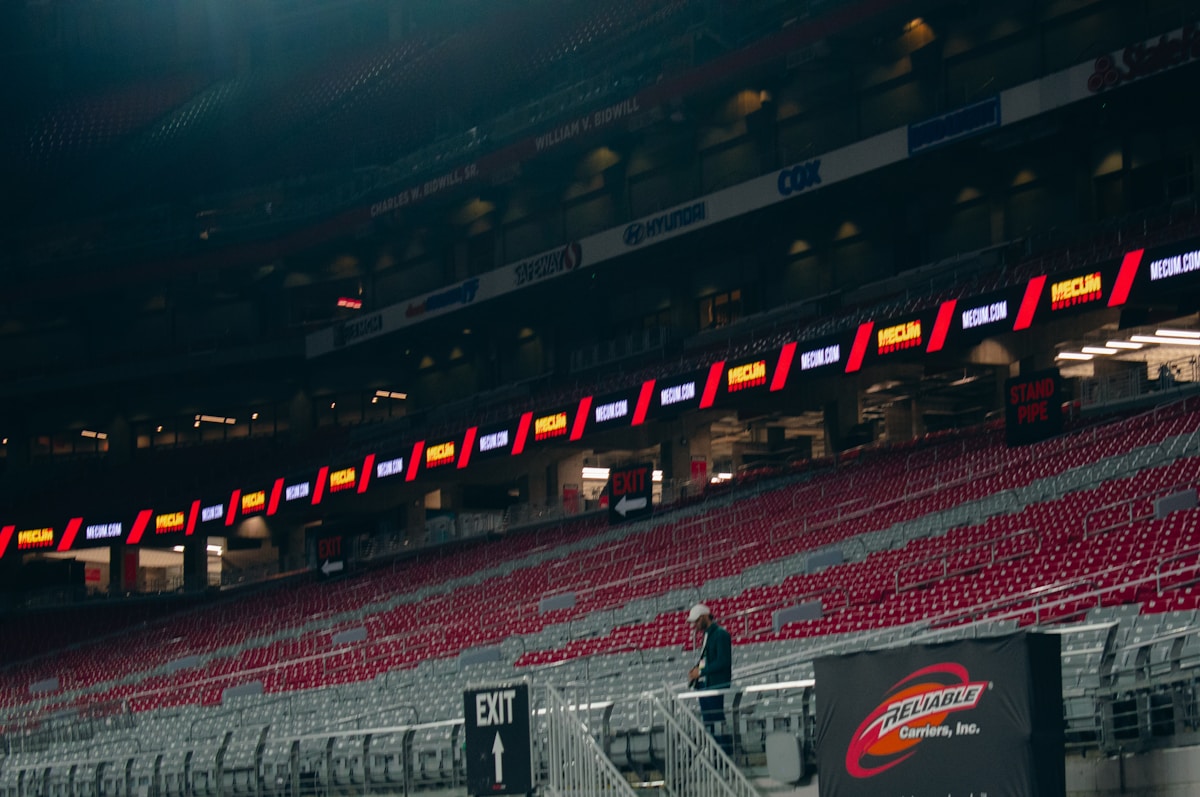
When a 2026 FIFA World Cup venue needs to broadcast live 4K video to 15 different zones simultaneously — scoreboard, ribbon LEDs, concession menus, executive suites, and public signage — the old way of running copper cables across concrete trenches just does not scale. The solution reshaping Dubai's smartest venues is not a product. It is an architecture: AV-over-IP and SDVoE.
Software Defined Video over Ethernet (SDVoE) is rapidly becoming the standard for large-scale digital display infrastructure in stadiums, arenas, and event venues across the UAE. By routing uncompressed 4K/60 video over standard 10Gbps Ethernet switches — rather than dedicated point-to-point hardware — venues gain flexibility, scalability, and a fraction of the traditional infrastructure cost.
Why AV-over-IP Is Replacing Legacy AV Infrastructure
Traditional AV installations require dedicated matrix switchers, extensive copper cabling, and complex hardware at every endpoint. As venues add more screens — for advertising, wayfinding, sponsorship, and fan engagement — the complexity grows exponentially.
AV-over-IP collapses this architecture into a single, standardized IP network. Any source — a live camera feed, aBrightSign media player, a graphics server — can be routed to any display endpoint using standard network switching. The result: a single infrastructure that adapts as the venue evolves.
For Dubai venues hosting international events — ILT20 cricket, World Cup qualifiers, Dubai Esports Festival — this flexibility is a competitive advantage. The same network that powers a live match broadcast can instantly reconfigure for a concert or a corporate conference.
SDVoE: The Technical Detail That Matters for Stadium Operators
Not all AV-over-IP is equal. SDVoE, backed by the SDVoE Alliance, specifies zero-latency, visually lossless 4K/60 4:4:4 video over 10G Ethernet. The latency is below 100 microseconds — imperceptible to the human eye and essential for live scoreboard synchronization.
For stadium operations teams, this means:
- Hardware consolidation: Matrix switching moves from dedicated AV hardware to software running on standard network switches
- Unlimited scaling: Configurations scale from 2x2 to 256x256 endpoints without hardware changeouts
- Centralized control: A single API manages the entire display ecosystem — reducing operational overhead on match days
Real-World Applications in Dubai and the UAE
Several UAE stadium projects, including upgrades at Al Maktoum Stadium and Dubai International Stadium, are leveraging IP-based AV infrastructure to support the demands of modern sports entertainment. The benefits extend across every touchpoint of the fan journey.
Pre-match and in-game: Live camera feeds route simultaneously to the main scoreboard, side panel LEDs, and mobile-app synchronized displays — all from one network. Sponsorship content updates in real-time across all zones without physical intervention.
Concessions and retail: Digital menu boards pull content from a central CMS, with pricing and promotions updating dynamically based on game phase, crowd density, or time of day. Queue management displays surface live wait times from IoT sensors.
Security and operations: IP-based AV integrates with venue security systems — CCTV feeds route to a central monitoring station alongside public display content, all on the same network infrastructure.
The BrightSign Player's Role in the SDVoE Ecosystem
BrightSign players — DigiComm's flagship product line for digital signage — are designed to integrate seamlessly into AV-over-IP environments. Their HTML5 rendering engine, hardware-based video decoding, and open API architecture make them ideal endpoints in a networked display ecosystem.
When a BrightSign player receives a content update over the network — whether a scheduled promotional loop or a real-time score overlay — that content can be distributed to any display in the venue via the IP infrastructure. No proprietary cabling, no dedicated hardware switchers required.
Energy Efficiency and the Smart Venue Imperative
Large venues face mounting pressure to reduce energy consumption and meet ESG targets. AV-over-IP supports this goal by eliminating redundant hardware and enabling intelligent power management across the display network. Screens can be dimmed or placed in sleep mode via scheduling based on event calendars — reducing power consumption by up to 40% compared to always-on legacy systems.
Sustainability-focused display manufacturers like SwedX, whose energy-efficient panels are distributed by DigiComm across MEA, complement this architecture by providing hardware that was designed from the ground up for low power draw and long operational life — critical for venues running hundreds of square meters of LED.
What Venue Operators and Event Planners Need to Know
If you are responsible for a stadium, exhibition centre, or large event venue in Dubai or the wider UAE, the case for AV-over-IP is clear. The infrastructure investment — often the single largest line item in a venue AV upgrade — now has a more flexible, more scalable, and more future-proof alternative.
Key decision points:
- Scale your display network without redesigning your infrastructure — add endpoints by connecting to your existing Ethernet switch
- Reduce hardware BOM — eliminate matrix switchers and proprietary extenders
- Enable real-time content control — push updates across all zones simultaneously from a cloud-based CMS
- Prepare for 8K — SDVoE's 10G architecture is already engineered for next-generation display content
Conclusion: An Infrastructure Decision That Outlasts Any Single Event
The venues that will dominate fan experiences in 2026 and beyond are not choosing screens — they are choosing network architectures. AV-over-IP and SDVoE give Dubai's stadium operators and event venues a single, scalable, software-defined foundation that will serve them through multiple generations of display technology.
DigiComm works with venue operators, system integrators, and event production companies across the UAE to design, supply, and commission AV-over-IP display infrastructure. Our team combines deep knowledge of SDVoE standards, BrightSign endpoint configuration, and venue-specific network design to deliver installations that perform on match day and scale over time.
Ready to upgrade your venue's display infrastructure? Get in touch to discuss your project.